How to split poker chips for any number of players
You bought a 500-chip set because the box said it seats up to 10. Then 10 people actually showed up, you tipped the tray onto the table, and realised nobody knows how many of each colour a player should start with. Someone grabs a fistful. Someone else counts out a neat tower. Two players have wildly different stacks and the game hasn't even dealt a hand.
Splitting chips is not hard maths, but it has a few rules that aren't obvious until you've got them wrong once. This guide covers all of them, including the one that catches out almost every home game: what to do when your set physically can't cover the table. You can do the whole thing with pen and paper. We also built a calculator that does it in about three seconds, and there's a link to it further down once you understand what it's actually doing.
Start with the starting stack, not the chips
The first number to settle is the starting stack: how many chip-value points each player begins with. Not how many physical chips, the total value. A player starting with 10,000 might hold 30 chips or 54, depending on denominations, but the value is fixed at 10,000.
People reach for the chips first and the stack size second. That's backwards. Pick the stack first, because it decides how long your night runs. A bigger starting stack means more chips in play, which means players can absorb more bad hands before busting, which means a longer game.
Here's a rough feel for it:
| Starting stack | Style | Roughly |
|---|---|---|
| 5,000 | Fast | Short session, quick blinds, good for a weeknight |
| 10,000 | Recommended | The default for most home games |
| 20,000 | Deep | Long, patient session, more post-flop play |
| 50,000 | Ultra deep | All night, serious players only |
If you're not sure, start at 10,000. It's the sweet spot for a 6 to 10 player home game and it's what most people mean when they say "normal" stack. The number itself is arbitrary, what matters is that everyone gets the same one and that the value can be built from the chips you own.
The standard poker starting chips
If you just want the default most home games run, start here. The standard poker chip values are the ladder nearly every set follows - white 1, red 5, green 25, black 100, purple 500, gold 1,000 - and the standard starting chips are 50 to 75 physical chips per player, weighted heavily toward the two smallest colours.
For the classic table - 6 players, a standard 500 piece set, 5,000 point stacks - the standard deal per player looks like this:
| Colour | Value | Per player |
|---|---|---|
| White | 1 | 20 |
| Red | 5 | 16 |
| Green | 25 | 8 |
| Black | 100 | 7 |
| Purple | 500 | 4 |
| Gold | 1,000 | 2 |
| Total | 57 chips = 5,000 |
Those numbers come from the same allocation algorithm the calculator runs, and the poker chip setup for 6 players page walks through them in full, alongside the 300 and 1,000 piece versions. Push the stack to 10,000 on the same 500 piece box and the value runs out - which is exactly the situation the worked example below untangles. So treat the standard as a starting point: the shape of the stack transfers to any table, even when the exact counts don't.
The rule that makes blinds playable: smallest chip first
This is the part most people miss. When you build a stack, you don't just hand out an equal pile of every colour. You build from the smallest denomination up.
Why? Because early in the game the blinds are tiny. If your small blind is 25 and a player's smallest chip is worth 100, they literally cannot post a small blind without overpaying. The game breaks on hand one. You need enough low-value chips in each stack to actually make the early bets.
So the principle is: give each player a working number of your smallest chips first, then a few of the next size up, then fewer of the next, and only a couple of the big ones to top the stack off to the target value. A correct stack looks like a pyramid, lots of small chips at the base, a handful of big chips at the top.
The big chips aren't there to be bet in level one. They're there so the total adds up and so players have something to colour-up into later when the small chips get cleared off the table.
A worked example: 6 players, 10,000 stack, and a set that's too small
Let's build it for real, snag included. Say Marie is hosting. Six players, she wants a 10,000 starting stack, and she owns a standard 6-colour set:
| Colour | Value | Owned |
|---|---|---|
| White | 1 | 150 |
| Red | 5 | 100 |
| Green | 25 | 100 |
| Black | 100 | 100 |
| Purple | 500 | 25 |
| Gold | 1,000 | 25 |
First check: can the set even cover 6 stacks of 10,000? That's 60,000 of value needed. Add up what's in the box: white 150, red 500, green 2,500, black 10,000, purple 12,500, gold 25,000. That comes to 50,650 of total value. Marie is short. There is not enough chip value in the entire set to give 6 players 10,000 each, and no clever distribution fixes that. The value simply isn't there.
This is the wall almost every home set hits once the table fills up. A box sized for 10 players can still run out of value once starting stacks reach 5,000 or more, because the small denominations eat into the count without adding much value, and there are never enough of the big ones.
You have a few ways out: lower the starting stack, drop a player, or the cleanest fix, change what a colour is worth.
The fix: promote a low chip to a higher value
Here's the trick that saves the night. You take a denomination you barely use and re-label it as a higher one. The white 1-chips are nearly useless at a 10,000 stack, the smallest blind you'd realistically run is 25, so a chip worth 1 never gets bet. So treat the whites as 1,000s instead, and retire the gold 1K chips you were short on.
Marie owns 150 whites. Promoted to 1,000 each, that's 150,000 of fresh value, and it replaces the 25 golds she didn't have enough of. Now the set has more than enough to cover 6 stacks of 10,000, and crucially she has a deep supply of high-value chips to build the top of each stack from. Not to mention, plenty of chips for future rebuys.
This is exactly what the calculator offers when you press calculate on an impossible set. It detects the shortfall and prompts: treat 1 chips as 1,000. Accept it, and it rebuilds every stack around the promoted chip.
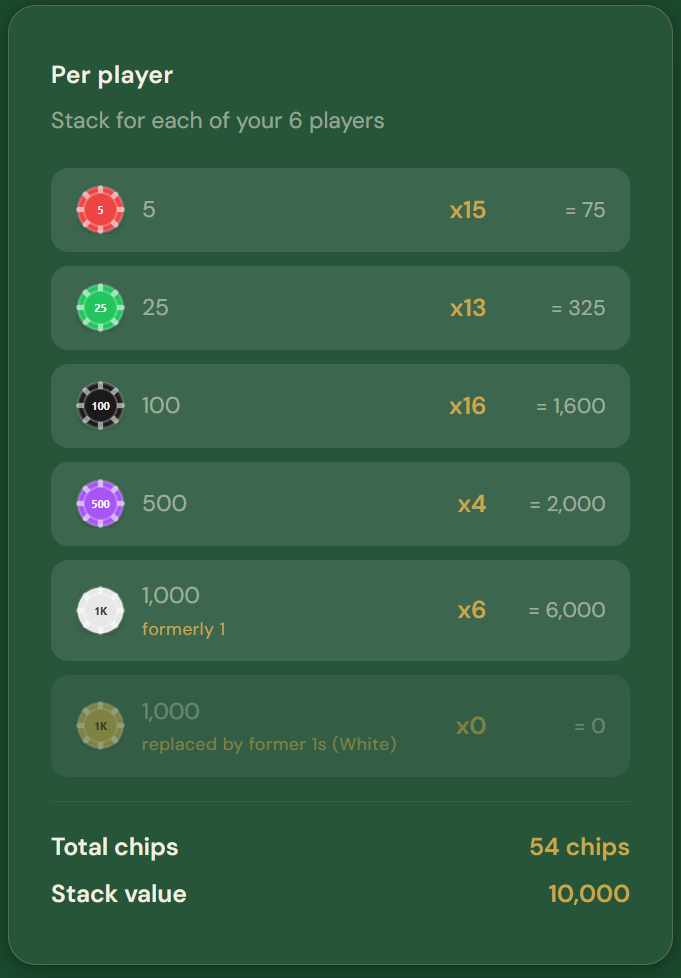
Here's what each player ends up with after the promotion:
| Colour | Value | Per player | Subtotal |
|---|---|---|---|
| Red | 5 | 15 | 75 |
| Green | 25 | 13 | 325 |
| Black | 100 | 16 | 1,600 |
| Purple | 500 | 4 | 2,000 |
| White (now 1,000) | 1,000 | 6 | 6,000 |
| Total | 54 chips | 10,000 |
The gold 1K chips sit out, replaced by the promoted whites. Each player gets a stack worth exactly 10,000, with plenty of reds and greens at the base for the early blinds and the promoted whites carrying the weight at the top. Across all 6 players that's 324 chips, inside what Marie owns of every active colour.
When promotion isn't the answer
Promoting a chip is the right move when you're short on high-value chips but have a pile of low ones going spare, which is the usual home-set problem. A couple of other situations call for different fixes:
You run out of a mid denomination rather than a small one. If you've got plenty of whites and golds but only a handful of greens, promotion doesn't help. Lower the starting stack so the build needs fewer of the scarce colour, or accept slightly uneven small-chip counts, the blinds only care that everyone has some low chips, not the exact same number.
You're one or two chips short of a clean total. Don't rebuild everything. Drop the starting stack a touch (9,500 instead of 10,000 costs nobody anything as long as it's equal for all) and the maths lands.
Borrowing from a second set works too, as long as the colours and values match exactly. Mismatched sets cause arguments at cash-out, so agree every colour's value out loud before the first hand.
Let the blinds follow the chips
One thing falls out of doing this properly: the chips you have most of decide where the blinds should start. The calculator looks at your built stack, picks the most abundant denomination as the workhorse for the early levels, and then checks the starting stack depth so the opening blinds land in a friendly 100-to-200 big-blind range. In Marie's promoted setup the reds and greens are the workhorses, so a Standard structure opening at 25/50 lets everyone play those early chips without anyone overpaying a small blind.
Match the blind speed to the stack you built. A big stack with fast blinds ends early anyway, so a deep stack you carefully assembled gets wasted on a turbo structure. The calculator suggests Turbo, Standard, or Deep based on the chips you actually own and the stack size, which saves you reverse-engineering it.
Once the chips are sorted
Splitting chips is the setup. The other half of a home game is the bit at the end, when everyone's counting winnings and trying to remember who rebought twice. If you're running a tournament-style night with buy-ins and payouts, our guide to running a home poker tournament covers the full arc, and when it's over, working out who pays who without 12 separate transfers is its own small headache worth solving cleanly.
For now, you've got the chips. Build smallest-first, promote a spare colour if the box runs short, and let the blinds follow.
Ready-made setups by player count
The method above works for any table. For the common counts we've also published the exact distributions, worked out across 300, 500, and 1,000 piece sets with the same algorithm the calculator uses: poker chip setup for 6 players, the classic home table and its sweet spots, poker chip setup for 4 players, the one table size deep enough to fund 10,000-point stacks off a 300-chip set, poker chip setup for 8 players, where the small sets start showing their limits, and poker chip setup for 10 players, the full ring, where only a 1,000-chip set does the job.
Run the whole night with PokerPall
Free tools on the web. The full experience in the app — live timer, chip setup, rebuys, and a settlement card at the end.
Common questions
What are the standard poker starting chips?
The standard home game deal is a 5,000 to 10,000 point stack built from 50 to 75 chips per player, weighted toward the small denominations. With a standard 500 piece set at 5,000 points that's 20 whites, 16 reds, 8 greens, 7 blacks, 4 purples and 2 golds - 57 chips per player.
What are the standard poker chip values for a home game?
Most sets follow the classic ladder: white 1, red 5, green 25, black 100, purple 500 and gold 1,000. The printed numbers matter less than the ratio - each denomination should be worth roughly 4 to 5 times the one below it, so you can colour up cleanly as the blinds rise.
How many poker chips does each player get?
Between 50 and 75 chips per player is the comfortable range for a tournament, built smallest denomination first. The total point value matters less than having enough low chips in each stack to actually post the early blinds.
How do you split poker chips for any number of players?
Pick the starting stack value first, then build each stack from your smallest denomination up - lots of small chips at the base, a couple of big ones on top. If the set can't cover every player, promote a spare low colour to a higher value rather than dealing uneven stacks.